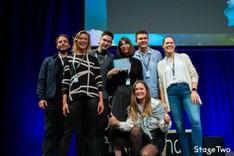
Nominations
In 2026, Stage Two gathers 50+ startups nominated by 45+ university-affiliated entrepreneurship centers and 4 wildcards. All spin-offs will pitch their business models live in front of more than 70+ top European venture capital firms and 30+ industry leaders.
Movement Award
Media Budget
+ € 5 Million
Investments
Skilling & Accelerate
Workshops
Nominees

aiXopt
RWTH Aachen University
Industry 4.0
b2b
→ aixopt.aiIndustry 4.0
b2b

Algaenius
Erasmus University Rotterdam
CleanTech
b2b
→ algaenius.nl/CleanTech
b2b

Bedrock Group AS
NTNU Trondheim
Industry 4.0
b2b
bedrockchain.comIndustry 4.0
b2b

BHUMI
University of Warsaw
BioTech
b2b & b2c
→ bhumi.plBioTech
b2b & b2c

C-SAW
Aalborg University
DeepTech
b2b
DeepTech
b2b

catchfree
University St. Gallen
Agri- & FoodTech
b2b
catchfree.chAgri- & FoodTech
b2b

CIYANO
Technical University of Berlin
DeepTech
b2b
→ ciyano.com/DeepTech
b2b

Cloq
Oxford University
DeepTech
b2b
→ linkedin.com/company/quantum-cloq/DeepTech
b2b

DExMed
Universitatea Babes-Bolyai (UBB)
MedTech
b2b & b2c
MedTech
b2b & b2c

EASE
Technical University of Munich
Logistics & Supply Chain
b2b
→ ease-systems.de/Logistics & Supply Chain
b2b

Fidolyx
Ghent University
BioTech
b2b
→ fidolyx.com/BioTech
b2b

FlyToKite
Gdańsk University of Technology
TravelTech + SportTech
b2b & b2c
→ fly2kite.com/TravelTech + SportTech
b2b & b2c

Foxtrot Aviation
ESCP
Mobility
b2b
→ foxtrot-aviation.com/Mobility
b2b

FreeForm Photonics
Heriot Watt University
DeepTech
b2b
→ freeformphotonics.comDeepTech
b2b

GM Labs
Comenius University
BioTech
b2b
→ gmlabs.skBioTech
b2b

Graini
HHL Leipzig Graduate School of Management
Circular Economy
b2c
→ grain-to-goodness.lovable.app/Circular Economy
b2c

hightrac
Agri- & FoodTech
b2b

Khoch3 KlimaKarten
WU Wien - Vienna University of Economics and Business
GovTech & ClimateTech
b2b
→ khoch3klimakarten.deGovTech & ClimateTech
b2b

Klared
TU Wien
Data & AI
b2b
→ klared.comData & AI
b2b

Korall
Chalmers University of Technology
CleanTech
b2b
→ korall.ccCleanTech
b2b

Magnetic Future
University of Bologna
DeepTech
b2b
→ magneticfuture.euDeepTech
b2b

MEDQUS
Lund University
MedTech
b2b
→ medqus.comMedTech
b2b

MINDSETOR
Maastricht University
MedTech
b2b
→ mindsetor.comMedTech
b2b

MolecularWorks
Stockholm School of Economics
DeepTech
b2b
→ molecularworks.bio/DeepTech
b2b

MicroJect
University College Dublin
MedTech
b2b
→ microject.ie/MedTech
b2b

Object Fingerprint
Prague University of Economics and Business
MedTech
b2b
→ objectfingerprint.com/MedTech
b2b

Orison Solution Ltd
London Business School
Food Manufacturing Technology
b2b
→ orisonsolution.co.uk/Food Manufacturing Technology
b2b

photreon
KIT Karlsruhe
DeepTech
b2b
→ photreon.comDeepTech
b2b

PicoShape
Ruhr Universität Bochum
DeepTech
b2b
→ picoshape.comDeepTech
b2b

Polytecks
University of Cambridge
DeepTech
b2b
→ polytecks.com/DeepTech
b2b

PortLink
Alba Graduate Business School
Shipping
b2b
Shipping
b2b
Prehensio GmbH
WHU - Otto Beisheim School of Management
DeepTech
b2b
→ prehensio.aiDeepTech
b2b

promethence
SDA Bocconi School of Management
DeepTech
b2b
→ promethence.net/DeepTech
b2b

Respira Technologies B.V.
Amsterdam
DeepTech
b2b
respiratechnology.comDeepTech
b2b

Savvio AI
Universität Graz
Corporate Learning / HR Tech
b2b
→ savvio.ai/Corporate Learning / HR Tech
b2b

SimOSpine
ESADE
Digital Health
b2b
Digital Health
b2b

SkyLign
KU Leuven
CleanTech
b2b
→ skylign.eu/CleanTech
b2b

SPARCS
Universidade NOVA de Lisboa
CleanTech
b2b & b2c
CleanTech
b2b & b2c

SwyTest
Riga Technical University
MedTech
b2b
MedTech
b2b

Theia Sense
i3P Politecnico Turino
DeepTech
b2b
→ theiasense.com/DeepTech
b2b

VAir
École Polytechnique de Paris
MedTech
b2b
→ vair.devMedTech
b2b

VALYRA AEROSPACE
UPV Universitat Politecnica de Valencia
Engineering
b2b & b2c
→ valyra.aero/Engineering
b2b & b2c

VisaFlow
University of Cologne
LegalTech
b2b & b2c
→ visaflow.app/LegalTech
b2b & b2c
Prizes
100.000
Innovation Award
Media Budget by DvH Ventures
sponsored by

1.000.000
Investment Opportunity
Potential Investment Opportunity (subject to DD) by World Fund
In collaboration with

850.000
HTGF German Deep Tech Award
Investment Opportunity (subject to DD) by HTGF
In collaboration with

750.000
Investment Prize
Investment Opportunity (subject to DD) by Mito Technology Ventures
In collaboration with

750.000
Investment Prize
Investment Opportunity (subject to DD) by Redstone
In collaboration with

500.000
Investment Prize
Investment Opportunity (subject to DD) by Nucleus Capital
In collaboration

500.000
Investment Prize
Investment Opportunity (subject to DD) by Creator Fund
In collaboration

500.000
Investment Prize
Investment Opportunity (subject to DD) by Atlantic Labs
In collaboration with

400.000
Investment Prize
Investment Opportunity (subject to DD) by caesar.
In collaboration with

350.000
Investment Prize
Investment Opportunity (subject to DD) by Marvelous.
In collaboration with

Fast-track to IC
Accelerate
Accelerate Prize (fast-track to IC) by Armilar VP
In collaboration with

Fast-track to IC
Accelerate
Accelerate Prize (fast-track to IC) by APEX Ventures
In collaboration with

Workshop
Accelerate
Go-to-Market Workshop by UVC
In collaboration with

Workshop
Accelerate
Tech-to-Market Strategy by Visionaries
In collaboration with

Workshop
Accelerate
Scale Across the Atlantic – Founder Access Pass by Drumbeat Capital
In collaboration with

Workshop
Accelerate
Launch & Lift by NAP
In collaboration with

Workshop
Skilling
Problem Solving Workshop by McKinsey
sponsored by

Workshop
Skilling
Technical Consulting for Industrial Production & Process Optimization
sponsored by

Workshop
Skilling
Production Catalyst Prize by Gateway Factory
sponsored by

Workshop
Skilling
Tech for Good Award by Value for Good
sponsored by

Outstanding Innovation Enabler
Cash Prize
7000€ for the 1st Place by Jackstädt Foundation
sponsored by

Outstanding Innovation Enabler
Cash Prize
5000€ for the 2nd Place by Jackstädt Foundation
sponsored by
Outstanding Innovation Enabler
Cash Prize
3000€ for the 3rd Place by Jackstädt Foundation
sponsored by